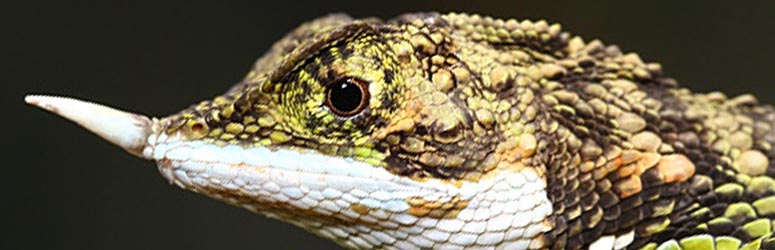
Ceratophora stoddarti, Length of head once a half to twice its breadth; snout longer than the orbit; nasal scale somewhat craterlike, separated from appendage by three scales, separated from its fellow by six scales; mental small, separating first post mentals; scales on chin quadrangular, the rows nearest the labials larger than ventrals; four canthal scales the canthus rather rounded; a pair of low pyramidal scales in frontal region; upper head-scales large, irregular, the supra orbital ones keeled; occiput with regular tubercles. Supra oculars irregular, the inner row largest separated from its fellow by three small scale rows, the last four scales of inner row pass behind eye; a pair of knobs in parietal region, covered by few large scales and separated from each other by seven scales; two large, prominent, elevated scales in temporal region above tympanum. A well developed dorsal crest on neck, dorsal scales very unequal, smooth or feebly keeled, pointing backwards and upwards; gular scales large, sub quadrangular, smooth or feebly keeled, larger than ventrals, forming regular longitudinal rows, those on the median line smaller; ventral scales smaller than the gular, smooth or feebly keeled. Limbs moderate; forth toe extending well beyond third; the hind limb reaches to the eye, or not quite so far. Tail slightly compressed, slender, covered with sub equal keeled scales. A low denticulate nuchal fold, a prominent rostral appendage restricted to the rostral scale, smooth, pointed, conical, about as long as the snout in the male, shorter, occasionally reduced to mere tubercle, in female, and its base surrounded by a median pair of Supralabials and five other small scales. No femoral or preanal pores. SUP: 9-14, INF: 9-13, SVL: 80-85 mm; TAL: 162-175 mm; HL: 25 mm (Deraniyagala, 1953; Smith, 1935 Taylor, 1953).
The body color is changeable from brownish green, yellowish brown and Olive green above, with more or less distinct brown cross bars on the back, sides and limbs; frequently a white mark behind the eye and another a narrow white stripe between eye and gape. Rostral appendage white and often the upper lip and throat also; belly usually grayish, white or yellow; tail with light and dark annuli (Deraniyagala, 1953; Smith, 1935 Taylor, 1953).
A horn lizard is found on moss-covered tree trunks widespread from the cloud forests and montane forests of central hills in Sri Lanka A slow moving, arboreal species, found on trees one or two meters above ground. Cypress trees are preferred and it is known to hunt for invertebrates on the ground (Das & De Silva, 2005; Manamendra-Arachchi & Liyanage, 1994).
Egg laying takes place in July and 2 – 5 eggs, measuring 7.6-8.1 x 13.5-14.5 mm, are deposited in a hole, and hatch after 81-90 days, although newly emerged ones have been found in the wild also during the cooler months. When threatened, it opens its mouth wide, revealing the bright orange lining on the oral cavity (Das & De Silva, 2005; Ilangakoon, 1990).
Conservation status: Endangered (Manamendra-Arachchi & Liyanage, 1994; Bahir & Surasinghe, 2005; IUCN, 2007).
|